14.03.1882 · uncertain date
Letter from Camille Pissarro to Theodore Duret
In this letter, Pissarro entrusts to his friend and support Theodore Durand his serious financial difficulties. Despite the misery that weighs on his daily life and hinders his creative momentum, he reaffirms his absolute determination to paint according to his own vision, in complete breach of academic rules. He mentions Paul Gauguin's punctual help (who bought him a canvas) and observes with a point of resignation the emerging commercial success of his colleagues Claude Monet and Auguste Renoir.
- Sender
- Camille Pissarro
- Recipient
- Duret Theodore
- Place sent
- Osny (Val-d'Oise, France)
- Original language
- French
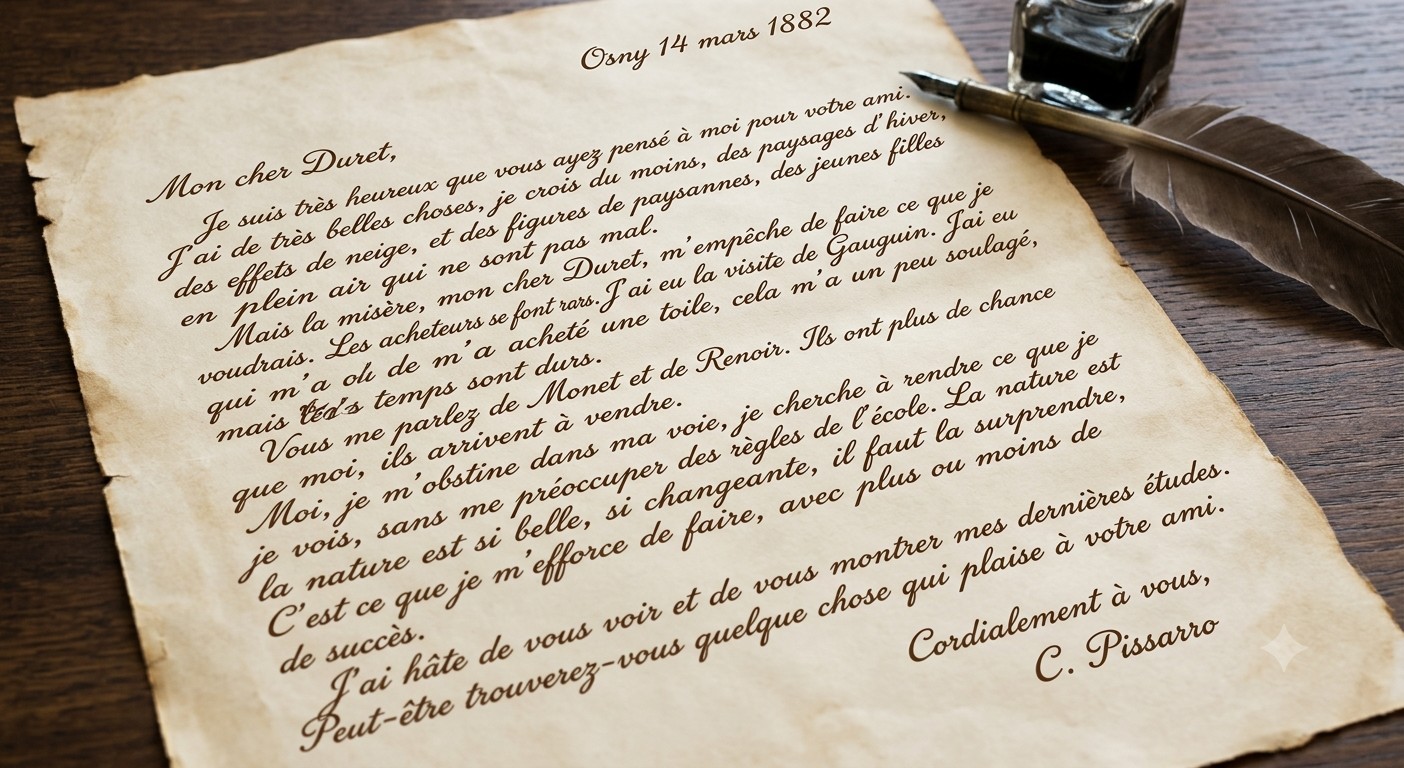
Letter text
Transcription
My dear Duret,
I'm very glad you thought about me for your friend. I have very nice things, I think at least, winter landscapes, snow effects, and peasant figures, young girls in the open that are not bad.
But misery, my dear Duret, prevents me from doing what I want. Buyers are scarce. I had a visit from Gauguin, who bought me a canvas, which made me feel a little relieved, but the times are hard.
You're talking about Monet and Renoir. They're more lucky than I am, they can sell. I stick to my path, I try to give back what I see, without worrying about school rules. Nature is so beautiful, so changing, you have to surprise it, seize it in flight. That is what I am trying to do, with varying degrees of success.
I look forward to seeing you and showing you my latest studies. Perhaps you will find something that pleases your friend.
Regrettably to you,
C. Pissarro
Context
Editorial note
Theodore Duret was one of the very first art critics to understand, theorize and defend the aesthetics of the group (notably through the publication of his brochure Les Peintres Impressionistes in 1878). He often acted as an intermediary between painters and wealthy Parisian collectors.
This spring 1882 letter is an essential historical document. It illustrates the tenacious precariousness in which some pioneers of the Impressionist group still lived, even a decade after their first avant-garde exhibition in 1874. While Pissarro has the heavy burden of a large family, he contrasts his situation with that of Monet or Renoir who are just beginning to get out of misery thanks to merchants such as Paul Durand-Ruel or Georges Petit.
Beyond the call for financial assistance, it is a real personal manifesto: Pissarro delivers his definition of Impressionism ("Nature is so beautiful, so changing, we must surprise it, seize it in flight") and proves that its artistic intransigence passes before its material comfort.