Technical · 21.07.2026
Why does Pissarro always go back to the roads?
Roads, trails and diagonals organize the look in many landscapes.
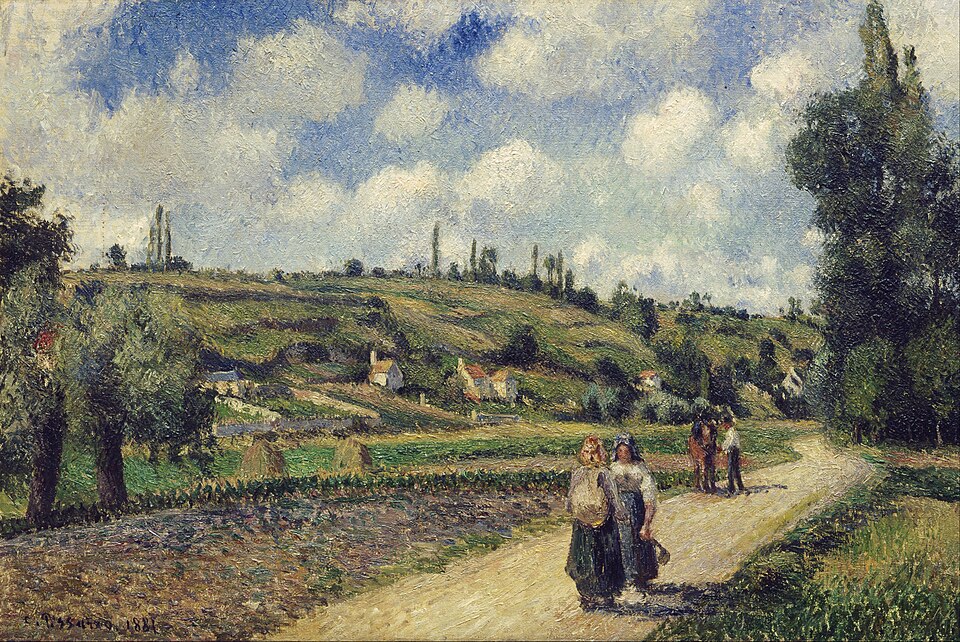
Routes, paths and diagonals organize the look in many of Camille Pissarro's landscapes. But the path is not only a process of composition: it links places, human beings and daily activities.
In the landscapes of Camille Pissarro, the gaze often encounters a dirt road, a path rising between the fields or a road crossing a village. Sometimes wide and clearly drawn, sometimes almost erased in the vegetation, this line leads to the heart of the painting.
The path seems to invite us to enter the landscape.
At Pissarro, however, it is not simply a decor. It organizes space, gives direction to the look and tells how the inhabitants live and travel their territory.
A line that brings into the table
A landscape painted on a flat surface must give the impression of depth. To achieve this, Pissarro frequently uses roads and trails as escape lines.
The path can begin in the foreground, sometimes close to the lower edge of the canvas, and then shrink away. It can also bypass a tree, climb a slope or disappear behind a house.
This progression naturally guides the look.
In La Côte du Jallais, Pontoise, painted in 1867, the road forms a broad curve that crosses the landscape and leads to the sunlit walkers. The Metropolitan Museum of Art specifically highlights the role of this curve, which structures the composition and animates the scene.
The viewer therefore does not contemplate the landscape from the outside. He almost feels like he can follow the road, cross the distance and reach the characters.
Rarely deserted paths
The Pissarro roads are often travelled.
There are peasants, women returning from work, shepherds, walkers, carts or animals. In some works, these figures are tiny. However, they are sufficient to give the landscape a ladder and to recall that it is a inhabited space.
In Le Chemin des Mathurins ascending through fields, Pontoise, realized in 1879, the path climbed the slope in the middle of cultivated land. A lean peasant appears in this environment where agricultural work, the hill, the trees and the village combine.
The road then links several realities: the house and the field, the village and the countryside, the place of life and the workplace.
Contrary to an ideal nature, preserved from any human presence, the landscape of Pissarro shows a land transformed and used every day.
# Paint the landscape at man height
Pissarro is not just looking for spectacular sites. He is interested in familiar surroundings, ordinary roads and passages taken by the inhabitants.
In Pontoise, the steep topography offers a wide variety of views. The rising streets, hillsides, cultivated plots and buildings allow it to compose complex spaces where the countryside and the city meet continuously. Moreover, the Musée d'Orsay describes this mixture as one of the great riches of the Pontoisian landscape for the artist.
A road thus becomes a way of showing relief. Its slope reveals the shape of a hill. Its layout distinguishes the fields. Its curve bypasses a house or highlights the presence of a slope.
The path allows you to understand the territory before even identifying the exact place.
The diagonal, the motor of the gaze
Pissarro often uses compositions crossed by diagonals.
A road can start from an angle of the table, cut a field and reach the horizon. A fence can follow an opposite direction. The furrows, trees and roofs introduce other lines that respond.
The landscape then seems stable, but never motionless.
These diagonals produce a sensation of circulation. The look moves forward, hesitates, changes direction and gradually discovers the different plans of the painting.
Pissarro thus avoids too much theatrical or too symmetrical composition. Its paths do not necessarily lead to a spectacular monument or event. They can disappear behind a slope or get lost in the fields.
This lack of clearly visible destination makes the landscape more alive. The road seems to continue beyond what the canvas shows.
#A pattern observed from the early years
Pissarro's interest in roads appears very early.
In a drawing entitled Route de Montmorency, made around 1850-1860, a curved path already moves away between the fields. A small figure accompanied by an animal advances the landscape. The road, the land and the tree line are enough to build the depth of the scene.
This early presence shows that the path is not an occasional motive. It belongs to the way Pissarro observes and organizes the visible world.
Over the years, the painter will take over this structure in spring landscapes, snow scenes, village views and representations of rural work.
The seasons change, the light changes, but the path remains.
Between nature and human activity
At Pissarro, the campaign is not separated from society.
The fields have been ploughed. The hedges define the plots. Roads lead to farms and villages. The characters work, move or transport crops.
The Orsay Museum recalls that the landscapes of Pissarro are populated with signs of life: smoke coming out of the chimneys, peasants at work and roads leading to the fields.
The path perfectly represents this encounter between nature and human activity. It belongs to the ground, marries its curves and slopes, but it also bears witness to the repeated passage of the inhabitants.
It is both a form in the landscape and a trace of a collective presence.
An invitation to walk with the painter
Why does Pissarro return so often to the paths?
Because they allow him to build the depth, to circulate the gaze and to connect the different parts of the landscape. But also because they correspond to his vision of a rural world living, travelled and worked.
In his paintings, the path does not lead to an exceptional elsewhere. It crosses ordinary places which the painter patiently observes: a hillside of Pontoise, a village road, a field, a farm or a group of workers.
Following these painted routes, the viewer symbolically adopts Pissarro's own approach: to look slowly, to move forward in the landscape and to discover that the simplest patterns can become an inexhaustible source of painting.